
If you are looking for the greatest gold-mine of easy to use "change your dog's behavior" advice ever crammed into a newsletter series then read on!
"The Secrets to Dog Training books have been a tremendous help to me in gaining more control over my two dogs Neo & Molly especially as they were rather defiant at times. Both dogs are very loving, fun and loyal but I've had to get a dog behaviourist out in the past as Molly's a rescue dog, has a nervous disposition and a habit of going bonkers through fear by barking, growling and trying to nip/bite. I think she was abused before I got her as she is extremely scared of children and doesn't particularly like strangers and other dogs. She loves the family and those she knows but it was/is really worrying so the fear biting section has been great for tips on dealing with that.
They know now who's the alpha and don't try nearly as much nonsense as they used to. Obviously I'm not expecting them to change overnight, I realise I have to be rigorous in the re-training but so far they're coming along great! I really wish I'd heard/got the Secrets to Dog Training books years ago, in my opinion no dog owner should be without a copy. They're brilliant, very easy to understand/follow and they results are amazing!"
-- Kirsty Halleran (UK)
Hi Daniel,
Last year, I had to put my 13 year old pet to sleep. I am now contemplating getting a new puppy and a different breed, which I want to train. It has been so long since I have had a puppy and I have lost a bit of touch and I have a couple of questions. When you get them home for the first night and put them in their new bed, should you ignore their crying if so for how long. I don't want to traumatize the little thing. Also, should obedience training start straight away and for how long each time?
Finally he will be coming to work with me, but naturally he won't sit still in his bed what should I do to get him use to the office environment and how should I keep him confined without being cruel?
Regards,
Marie.
Hi Marie,
Thank you for your email.
I highly recommend that you get a crate for your new puppy. This will be excellent for all the training you have to do, but in particular if you are going to take him to work with you. I WOULD not have a new puppy without a crate, trust me you will feel the same once you bring your puppy home.
It pays to start as you mean to go on, so if you want to sleep through the whole night, as you usually would, then so should the puppy. If he whines and you wait and wait and wait, then go and see to the puppy, he will then have learnt, how long he has to whine in order to get what he wants, some company! Which is the worst thing you can do!
Ignore him totally, he will be upset and noisy to begin with, but no harm can come to him (especially if he is in a crate). He will learn after a couple of days that there is no point whining, because no one will hear so just have to wait until the morning and that's what you want!
It is a good idea to not give him any water at night, so that he doesn't drink and therefore urinate so much (unless he has diarrhea, in which case he will require the fluids so as to not dehydrate. Sometimes puppies have diarrhea when you first take them home because of the stress, as long as there is no blood in it this is quite normal).
You will probably find that the puppy will be quite happy at work with you, because you are there. If you don't want to get a crate then set up a bed and a toilet area, somewhere where you can tie him up. Always supervise a puppy that is tied up, as there is a potential strangle risk if you leave it to its own devices.
While you are toilet training, take the puppy out every hour on the hour so that he is not given the chance to ever go inside (unless there is no outside option for you). If he does have an accident inside, soak it up or pick it up with some newspaper and take it outside. Most puppies will not toilet in there crate unless they really have to because they do not like going near where they like to sleep.
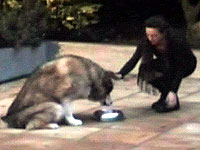 Kingdom of Pets dog trainer, Brain Heward deals with the issues of dominance and food bowl aggression while working with a dominate Alaskan malamute name Kahn in the Infield Training DVD. By watching this DVD you will see the actual training steps he uses to correct this aggressively dominant dog to one that knows its place in the pack. To find out more about these training steps and steps to deal with other dog behavioral problems Click Here. So much is covered in this amazing Dog Obedience Training DVD
Series.
Kingdom of Pets dog trainer, Brain Heward deals with the issues of dominance and food bowl aggression while working with a dominate Alaskan malamute name Kahn in the Infield Training DVD. By watching this DVD you will see the actual training steps he uses to correct this aggressively dominant dog to one that knows its place in the pack. To find out more about these training steps and steps to deal with other dog behavioral problems Click Here. So much is covered in this amazing Dog Obedience Training DVD
Series.
Kind regards,

Daniel Stevens and the Secrets to Dog Training Team
 I've been a professional dog trainer for well over 20 years, and in that time I've helped thousands of dog owners just like you to get the friendly, well behaved, slipper fetching, best pal they always wanted.
But it didn't start out that way. I've always loved dogs, some things never change. But when I first started my professional dog training career I relied on the so-called 'best practices' when it came to dog behavior training. It was only when I heard people tell me over and over again that they just weren't seeing results that I started to question the old accepted wisdom. So I started a journey, a quest to search out the best, most effective, techniques, tips, and tricks that really work.
And that's how I came up with Secrets to Dog Training. Year after year I found new techniques that achieved the results I wanted. Eventually I had a whole book worth of great resources: Secrets to Dog training...
So, if you want to:
Then Secrets to Dog Training is just what you've been looking for!
Previous Newsletters
| 01 | 02 | 03 | 04 | 05 | 06 | 07 | 08 | 09 | 10 | 11 |