
“Come” training just not going well
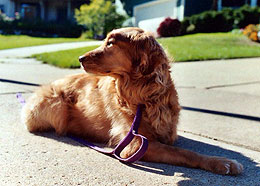 One of our members has a problem with a 12-month old Golden Retriever, Keesa, who is generally well-behaved while on a lead, but the moment the lead is off it’s a different story.
She writes: “I walk Keesa on a short lead in the street, in shops, pubs - you name it - and she is fine. To let her burn off energy I take her to a park where there are two large lakes. I keep her on a long "lunge" lead so she can have more freedom without being out of my control. I thought that once she had mastered the "Come" command, I could dispense with the lead.
On the lead she has not really mastered the “Come” command but she is at least 80% reliable, and when she responds quickly she gets high praise and treats. As soon as she has demonstrated that she is under control, I let her run free again.
However, if I let her OFF the lead she is 100% UNRELIABLE! She runs round in circles and then takes off in the direction of whatever she finds most interesting - other dogs, children, water etc. No treats are a match for the allure of FREEDOM. She knows I'm calling her (excited "fun" voice, of course) and she will often run gleefully towards me only to swerve at the last minute to avoid my outstretched arms and run off in the opposite direction.
People tell me she is doing well for her age – and she has learnt a lot of useful tricks – and apart from this ‘quirk’ I can take her anywhere with confidence. So what am I doing wrong with the recall? It really is my only issue and it's driving me nuts.
Kingdom of Pets replied:
When training, you should never give a command that you cannot immediately reinforce if your dog doesn’t give the desired response. For example, calling your dog to “Come” while she’s playing with another dog, chasing squirrels, or is far away from you is courting failure. If she doesn’t respond, there’s nothing you can do to enforce the command, so in effect you’re teaching her to ignore the command. Follow the pointers below to increase the effectiveness of your training:
Common mistakes to avoid when teaching “Come”:
- Don’t work on the ‘Come’ command with your dog OFF the leash until she is 100% reliable ON the leash – in a wide range of situations and a variety of leash lengths.
- Use a cheery tone of voice when you call her, to make yourself an attractive prospect.
- Keep your posture welcoming when she’s still learning. If you squat down and open your arms out wide it will help to forge the association in her mind between the command and the desired action. Most dogs respond instinctively to this. With some dogs excitedly moving backwards is more effective as this makes coming more of a game.
- Do not repeat commands. When you ask your dog to “Come”, say the word once. If she doesn’t respond, reinforce it with a leash flick.
- Don’t overuse her name or eventually she’ll become immune to the sound of it.
The recall command “Come” is one of the most important commands you can teach your dog. It’s also one of the hardest on your dog. Whenever you ask her to “Come”, you’re asking her to leave something enjoyable and interesting to return to you. That’s a pretty big ask - and one of the most common complaints we hear is about dogs not coming when called.
The only way to ensure that your dog will “Come” every time is to spend a lot of time practicing and training in a variety of situations, and with varying levels of distraction, to ensure that she learns to respond to “Come” in every situation.
Key training tip:
As soon as your dog starts walking towards you, praise her in a low, encouraging tone of voice. “Goooood girl, what a goooood girl!” You want to praise her as she’s heading your way, so she associates the praise with walking in your direction. Keep your voice steady and low-pitched. Put a smile on your face for added effect. Overly-enthusiastic praise tends to distract the dog from what she’s doing.
The moment she reaches you, get that treat in her mouth as fast as you can. Some dogs prefer a short game with a cherished toy as an alternative reward to food treats: you’ll figure out which of these your dog prefers as training progresses. Good luck.
All the best,

Daniel Stevens and the Secrets to Dog Training Team
"Secrets to Dog Training - STOP Dog Behavior Problems!"
http://www.kingdomofpets.com/dogobediencetraining/
P.S. Forward this Newsletter to a friend
If you have a friend you think may be interested in training their dog or solving a particular dog behavior problem, please feel free to forward them this Newsletter.
P.P.S. Remember – you have full access to our Members’ Forum
Because you are a Member of ‘Secrets to Dog Training’ you have full access to our Members’ Forum. If you have a dog behavior question or a related problem, you are most welcome to bring it to the Forum. Post a detailed description for our trainers and fellow Members to read. Within 1-4 working days you will see recommendations on how to solve it once and for all.
If you haven’t already registered for the Forum, you can do this from the Members’ Area: http://www.kingdomofpets.com/dogobediencetraining/members/ or you can go straight there by clicking here – http://www.kingdomofpets.com/dog/forum/
Previous Newsletters
01 | 02 | 03 | 04 | 05 | 06 | 07 | 08 | 09 | 10 | 11 | 12 | 13 | 14 | 15 | 16 | 17