
Basic Training for Beginners
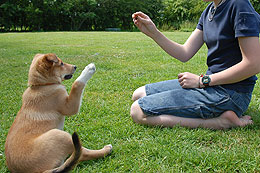 A member who has just acquired her first puppy asks the question that every new owner should ask – “What are the basic commands I should start with and in which order should they be taught?”
Kingdom of Pets replied:
The basic commands in a logical order are:
1. Come
2. Sit
3. Okay and No
4. Hold and Drop it
The training of these important commands is covered in detail in the e-book, Secrets to Dog Training but here they are in brief.
Sit:
This is the simplest command to teach and very important in the early education stages. It introduces your dog to training and teaches them to focus on voice and hand commands. You need your dog close to you, still and attentive. It can be taught to puppies at a very young age as it builds on a natural behavior. Down is basically an extension of the “sit” movement and can be taught as soon as “sit” is mastered.
Come:
The recall command “Come” is one of the most important commands you can teach your dog. It’s also one of the hardest for your dog to master. Whenever you ask him to “Come”, you’re often asking him to leave something he finds enjoyable and interesting to return to you. That’s a pretty big ask and it calls for a lot of training.
Okay and No:
“Okay” is the command that releases your pup from training. After that he’s on his own time. “No” or a throaty “AHH” is the only command which expresses your displeasure. Pick one and use it consistently. Once the wrong behavior stops – praise him to show you’re pleased he stopped.
Hold and Drop it:
Teaching your pup to take and keep an object in his mouth – and release it on command – is a very useful core skill for later development.
Puppy School
Many veterinary clinics run puppy schools. Puppy schools teach several of the basic commands although not necessarily in the order given above. They are excellent for first time dog owners but even if you are confident and happy to train basic commands by yourself from the Secrets to Dog Training Manual you may still want to consider enrolling in a short puppy school course. This is because these classes offer your puppy valuable socialization with other dogs, children and people all in a safe environment. Puppies also become familiar and comfortable with veterinary clinics which can reduce problems and stress later. If you decide not to take your dog to puppy school please make sure you socialize your puppy well in other locations. Also consider asking the vet if you can bring your puppy in once a week to sniff around the vet clinic and get used to all the sights, sounds, and smells.
Successfully training your puppy
The seeds of a successful and rewarding partnership with your pet are sown in the first six months of the puppy’s life, starting at about 8-10 weeks of age. If you become close friends through talking to him, playing with him and taking him for walks, he will be much more responsive and attentive when you’re training him. Keep the emphasis on fun and be consistent in your commands. This builds a clear, black and white view of the world for your pup to easily understand.
Start with the basics and resist moving on too quickly. Revisit earlier exercises to refresh your puppy’s memory. Dogs learn by repetition so it will take several training sessions before an action can become automatic. Also refresher sessions will be needed so that the response is not lost. Having just one trainer is best. Keep training sessions short and enjoyable, a few minutes a day, so that your dog maintains concentration throughout. Quality not quantity is the golden rule, puppies have a short attention span so several short sessions is much better than one long one. Because your dog has the mental capacity of a toddler, be sure to praise quickly so your reaction links to the dog’s actions – no more than 2-3 seconds.
Always finish a training session on a positive note. If your dog is struggling with a new command finish the session by asking him to do commands he is familiar with and praising warmly when he responds correctly.
Puppies are most receptive to training from the age of six to eight weeks but it may take until the dog is 5 months old before it fully understands.
Key points:
- Bond with your dog by spending quality time with him.
- Be consistent. Make his world black and white not vague shades of grey.
- Praise or reprimand within a few seconds for him to associate it with his actions.
- Dogs learn by repetition so it will take time to for him to catch on.
- Quality not quantity is the best approach to training. Use short sessions often.
- Have a reasonable expectation of what your dog can do.
- Use praise whenever your dog does something right.
- Use eye contact as much as you can.
- Hand and voice signals are good ways to communicate with your dog.
- Use the Alarm-No!-Command method to reprimand.
A special note:
Remember to consult your vet as to when your puppy is safe to be socializing and outdoors. Puppy vaccinations are not effective immediately and in many cases your puppy will not be protected from severe diseases until one or more booster vaccines have been given.
All the best,

Daniel Stevens and the Secrets to Dog Training Team
"Secrets to Dog Training - STOP Dog Behavior Problems!"
http://www.kingdomofpets.com/dogobediencetraining/
P.S. Forward this Newsletter to a friend
If you have a friend you think may be interested in training their dog or solving a particular dog behavior problem, please feel free to forward them this Newsletter.
P.P.S. Remember – you have full access to our Members’ Forum
Because you are a Member of ‘Secrets to Dog Training’ you have full access to our Members’ Forum. If you have a dog behavior question or a related problem, you are most welcome to bring it to the Forum. Post a detailed description for our trainers and fellow Members to read. Within 1-4 working days you will see recommendations on how to solve it once and for all.
If you haven’t already registered for the Forum, you can do this from the Members’ Area: http://www.kingdomofpets.com/dogobediencetraining/members/ or you can go straight there by clicking here – http://www.kingdomofpets.com/dog/forum/
Previous Newsletters
01 | 02 | 03 | 04 | 05 | 06 | 07 | 08 | 09 | 10 | 11 | 12 | 13 | 14 | 15 | 16 | 17 | 18