
Excitement gets in the way
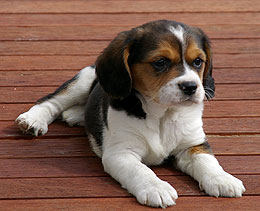 Miguel writes: Hey, I have a beagle puppy named Dubee. He’s wonderful and everything but I can’t seem to get his attention, sometimes, when I’m trying to teach him ‘Sit’. I’ve tried giving him a treat if he does it but then he just goes crazy for the treats and that’s all he wants from there on.
Can someone please help me?
Kingdom of Pets replies:
To train ‘Sit’
Hold a treat in your fingers, in front of his face, where your puppy can see it. Move the treat up and over his head so that as he follows the treat he automatically sits. While he is doing this, give the ‘Sit’ command. Once he is sitting correctly, give him the treat. After a while, when he has been doing well, give him praise rather than the food reward.
Keys to Effective Training of an Excited Puppy
When a dog is excited and bouncing around, he’s carried away on a wave of adrenaline and will not be receptive to your commands.
If your dog gets excited because he knows you have treats when you hold them in your hand – try keeping them in a pouch instead. If that doesn’t do the trick, remove treats from your training routine for a while – they’re obviously more of a distraction than anything. Instead try praise and toys as a reward.
There are also several other things to consider when working with an excited puppy:
Alpha-dog Training
It is important that your dog knows that you are his ‘pack leader’ or ‘alpha-dog’. If he knows you are in charge he is likely to have more respect for you and, as a result, will be more responsive to your commands and corrections. Make sure you practice alpha-dog training with your pup even from a young age as this will help to establish you as pack leader at a time where your dog is small and easy to handle. This will help prevent problems later.
Training Session Timing, Location and Length
Keep lessons short, just a few minutes is enough, but have them several times a day. Short, frequent training sessions will place less pressure on your dog’s attention span – which in puppies isn’t very long anyway. You could also consider choosing training times when your dog is less energetic – maybe after a good walk when he is more settled or at a time when his interest in food is less intense such as after a meal. Training in an area where there is a lot of stimulation such as loud noises will also reduce your puppies attention so try somewhere a bit quieter.
Using Your Attention as a Behaviour Modifier
You can show your dog that you do not want it to be bouncing around during training by ignoring him and removing eye contact as soon as he starts getting over excited. This will immediately reduce the excitement as your attention and treats is what makes it all exciting. As soon as your puppy calms down make eye contact again, praise him gently so as not to overexcite him again and then restart training.
Bonding
Your dog will be much more responsive and attentive when you have become his close friend so spend quality time with him. Talk to him, play with him and take him for long walks.
Attitude
You should ensure that you have the dog’s full attention and that you are giving your best when performing a training session. You may wish to settle yourself or the dog down by taking a long walk before the session commences. Try not to get mad if the training session is not going as you has hoped. If you find yourself getting frustrated it is better to come back to it later.
Praise
Remember to praise immediately after a good response as your dog will not associate the action with the reward if they occur too far apart. Look directly into his eyes so that he understands the connection between his action and your voice or touch. Deliver praise verbally or with the hand by either patting or stroking him. Remember - dogs really like your happy, encouraging tone of voice, but if your dog shows signs of getting too excited tone down the pitch and volume.
Hand Signals
Adding a specific hand motion when giving a vocal command trains your dog to respond to visual stimuli and is useful for getting response across long distances. Some dogs seem to respond best to visual signals so adding them early may help your training and keep your puppy focused.
Voice Signals
Dogs ‘understand’ commands by forming a connection between the sound you make and an action they carry out - rather than grasping the word’s actual meaning. Through repetition you help to lock in that connection.
Try to get eye contact with your puppy before giving a command so you know you have your dog’s attention right at the start. Reinforce this attention by saying his name before stating a command. For example, “Fudge…. SIT!” will attract your dog’s attention to the command to follow . Make all your commands clear and never use command words interchangeably as this will only make matters worse.
Training excited puppies can be hard work but once they get the hang of it there’ll be no looking back. Be reasonable in your expectations of what your dog can achieve because it will take time to get results. Have patience with your new puppy and make sure you remember to enjoy him. They’re only young once!
All the best,

Daniel Stevens and the Secrets to Dog Training Team
"Secrets to Dog Training - STOP Dog Behavior Problems!"
http://www.kingdomofpets.com/dogobediencetraining/
P.S. Forward this Newsletter to a friend
If you have a friend you think may be interested in training their dog or solving a particular dog behavior problem, please feel free to forward them this Newsletter.
P.P.S. Remember – you have full access to our Members’ Forum
Because you are a Member of ‘Secrets to Dog Training’ you have full access to our Members’ Forum. If you have a dog behavior question or a related problem, you are most welcome to bring it to the Forum. Post a detailed description for our trainers and fellow Members to read. Within 1-4 working days you will see recommendations on how to solve it once and for all.
If you haven’t already registered for the Forum, you can do this from the Members’ Area: http://www.kingdomofpets.com/dogobediencetraining/members/ or you can go straight there by clicking here – http://www.kingdomofpets.com/dog/forum/
Previous Newsletters
01 | 02 | 03 | 04 | 05 | 06 | 07 | 08 | 09 | 10 | 11 | 12 | 13 | 14 | 15 | 16 | 17 | 18 | 19