
Fixing a Biter: The Case of the Bossy Beardy
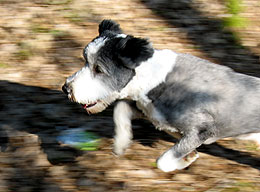 Gale writes: Our dog, D.J., was given to us by my dad who had adopted him from the pound. My children aged 8, 5 & 2, have fallen in love with him and so have I. He’s maybe 18 months old; part bearded Collie.
Our problem is: DJ bites. When we were combing DJ’s long hair to get the mats and knots out and he tried to bite me, I just thought maybe he was sensitive to grooming. When he hopped up on my bed (a no-no) and my daughter tried to get him off, he growled and tried to bite her. I figured he was still adjusting to our family.
When my 2-year-old pulled his tail and D.J. bit him on the arm (didn't break the skin), I thought, no one likes their tail pulled! Then the Dog Groomer told me that D.J. tried to bite while they were grooming, and they had to muzzle him. Last night D.J. was in his dog bed and my daughter was gently petting him. Suddenly he bit her and broke the skin. I had no excuse this time and I don't know what to do.
He’s a good-hearted dog that loves being a part of our family. When the children play around the house and outside, he trails along like he's one of the pack and lies next to them when they watch TV. I don't see how we can keep a dog that’s a danger, but he has so many good traits that I'm torn. Because the biting happened only occasionally it had been easier to rationalize until last night. Please help us.
We are broken hearted at the thought of giving D.J. away. Give me step by step instructions to stop this aggression and I will do it to see if D.J. can stay in our family.
Kingdom of Pets Replies:
Because Collies are particularly sensitive to fright, it is entirely possible that something happened in DJ's past that is leading him to panic and bite in some of the situations you have described.
When dogs panic they revert to purely instinctive behavior to survive – and that means growling, snapping and actually biting. The way to handle this is to de-sensitize D.J to what is scaring him – or to counter-condition him by building positive associations with the fright source. So long as you don’t try to hurry this process and you never reinforce his fear by comforting or rewarding it in other ways, this can be completely successful.
However from your email it sounds more as if D.J. thinks of himself as part of your pack. A senior member. In fact – the boss, or Alpha dog. D.J appears to be exhibiting classic Alpha dog behavior. He would never bite anyone if he saw them as being of a higher rank in the pack. D.J. growls and bites as you have described because he has an inflated idea of his own importance in the household (which he sees as his pack). He believes he is the senior dog so he behaves as a senior dog does. He displays dominant behavior and he punishes all those below him who deserve punishment – in short, everyone.
It is also most likely that he is not happy. The top position is not all gravy. D.J carries the full weight of responsibility for the safety of the pack and is probably feeling the stress. He supervises while the children play because he feels responsible for their well being. For the safety of the pack, and therefore his own safety, D.J will not let go of this role until someone else takes it over.
Put DJ in his place
It is very important to show a dog that it is actually at the bottom of your pack. While this might sound unfair and perhaps a bit mean, we have to remember that dog's do not think in the same way we do. They have a strong hierarchical instinct. Dogs that know their place (at the bottom) are happier and more secure because the Alpha dog carries the full responsibility for the pack - a very stressful role!
Use the Alpha techniques
Dogs can believe they’re higher than us if we allow them onto the furniture, or feed them before the human pack members have eaten. This can lead to disobedience and aggressive behavior. Please read and begin using the Alpha Techniques as set out in the bonus book. There are some simple things that you can do to teach D.J. that he is at the bottom of the pack, such as not allowing him on the furniture, and making him wait for all other family members to walk through doorways first.
Everyone in your family should use these techniques consistently to re-educate D.J. Without this, his behavior will not improve, and may get worse.
Make him work
Read the Dominance Treatment Program as set out in the main book. Teach your dog that he must work for every bit of attention he gets. This program may be difficult for everyone, especially the children, because it will require you to ignore DJ for long periods of time, but it is important to stick to the guidelines to get the full effect of the training.
Give him obedience lessons. Either you or your husband should take initial responsibility for the obedience training, then, once D.J. is responding well, you can have the children join in.
Never smack – this can easily be mistaken for a contest and provoke more biting. Also ensure that the children do not try to reprimand your dog – all reprimands should be left to an adult.
General Misbehavior
Whenever you catch D.J. behaving badly let out a guttural growl ("AAHH") to tell him he’s in trouble! The growl is very important, because it acts as a warning to stop the behavior immediately. This is the same technique that dogs use, so D.J. will know the message you’re trying to get across! As soon as the unwanted behavior stops, praise him. If the behavior doesn’t stop immediately give him a 3 minute time out by moving him to another room or putting him outside or in his kennel, this sends the clear message that you are the strong calm pack leader and will simply not tolerate this behavior in the pack. If you think you may have trouble moving him, keep a lead or lead and head collar on him initially to help you move him safely without dragging or pulling him, as this can also be interpreted as a challenge. Alternatively you can all ignore him and immediately exit the room, leaving him in there by himself.
Whichever time out method you chose to use, be consistent so that your dog understands that behaving well always brings rewards and praise where as misbehaving is of no benefit to him. You should soon have a happier and more well adjusted companion and family member.
All the best,

Daniel Stevens and the Secrets to Dog Training Team
"Secrets to Dog Training - STOP Dog Behavior Problems!"
http://www.kingdomofpets.com/dogobediencetraining/
P.S. Forward this Newsletter to a friend
If you have a friend you think may be interested in training their dog or solving a particular dog behavior problem, please feel free to forward them this Newsletter.
P.P.S. Remember – you have full access to our Members’ Forum
Because you are a Member of ‘Secrets to Dog Training’ you have full access to our Members’ Forum. If you have a dog behavior question or a related problem, you are most welcome to bring it to the Forum. Post a detailed description for our trainers and fellow Members to read. Within 1-4 working days you will see recommendations on how to solve it once and for all.
If you haven’t already registered for the Forum, you can do this from the Members’ Area: http://www.kingdomofpets.com/dogobediencetraining/members/ or you can go straight there by clicking here – http://www.kingdomofpets.com/dog/forum/
Previous Newsletters
01 | 02 | 03 | 04 | 05 | 06 | 07 | 08 | 09 | 10 | 11 | 12 | 13 | 14 | 15 | 16 | 17 | 18 | 19 | 20 | 21 | 22 | 23 | 24 | 25 | 26 | 27