
Over-Submissive Dogs – How do I get over it?
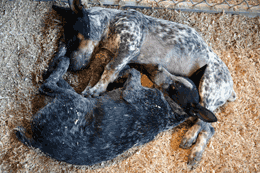 Nadine writes: We have two Australian cattle dogs - a male, Warren and a female, Wilma – both from different litters. We got Warren first, and because we wanted a confident female companion for him, at the breeder’s we chose a bitch that exhibited assertive behavior - Wilma.
Initially she continued her aggressive behavior such as not letting Warren eat before her. But as she matured she changed. To our surprise she began exhibiting overly-submissive behavior.
Now it has gotten much worse and includes behavior such as rolling over on her back, ears down, cowering, and so on. It's very difficult to teach her to do anything, like commands, and correcting bad behavior seems impossible.
We moved into an apartment for a year and boarded both dogs with some people who had a small ranch outside of town. My husband thinks the dogs were not monitored during feedings and Warren would steal Wilma’s food, reversing their initial ranking. We only saw them once a week and when we fed them we had to keep Warren from stealing her food.
Since then we’ve bought a house and brought them home and Warren's learned not to steal her food. But her attention-starved, overly-submissive behavior is very frustrating and concerning.
When we walk the dogs Wilma does very well on a leash, but playing in the back yard one on one or with Warren is a different matter. She has no interest in playing fetch or pull. She just wants to be petted all the time.
We've never been aggressive with her and are certain the people we boarded her with weren't either. We just want her to be a confident happy dog. Please could you help us!
Kingdom of Pets Replies:
Submissive behavior problems can often be rather difficult to tackle, as they could have been a result of a variety of different things. Generally, these sorts of problems arise from someone being overly aggressive or angry with the dogs when they were young, although this does not appear to the case here. It is possible that Warren may have been quite aggressive with Wilma once when she was trying to dominate him, and the fearful behavior has only been exacerbated ever since.
The most important thing to remember when dealing with over-submissive dogs is not to reassure her when she is exhibiting this nervous behavior. Although it seems to be unkind, by telling her ‘it’s alright’ when she is being fearful, you are only reinforcing her fear and telling her that there is something to be scared of. She looks up to you as the alpha dog and therefore her protector, and so it is up to you to act especially confident in these situations and not give her any reason to become scared at all.
To rectify this, you will need to see things from Wilma’s point of view. Although it may be difficult, try and understand what she is scared of and why this may be the case. Once you have established definite objects or situations that she is afraid of, you will need to desensitize her to them. This may include giving her treats and lots of attention when she is showing confident behavior in that situation, such as when Warren is around. It will take her some time to get used to the fact that nothing bad is going to happen. You will have to supervise the two dogs initially, just to ensure Warren doesn’t try to over-dominate Wilma. You can also counter-condition her to the thing she is scared of, which in this case would involve giving her treats in the presence of Warren. This may not be feasible though, as Warren may perceive this as you favoring her and become even more aggressive towards her. Warren is naturally the more dominant of the two dogs, and therefore needs to be treated as such. Trying to treat them equally will confuse and possibly worsen his behavior towards her.
Don’t forget that your dogs take their emotional and psychological cues from you, so keep up a cheerful and relaxed demeanor whenever you are dealing with them, so that they too will be less uptight. Socialize her as much as possible with a wide variety of different dogs, exposing her to lots of different situations and environments so that eventually you will find that nothing fazes her. The more she experiences, the easier it is for her to see that there is nothing to be afraid of. This will all take time, as you need to advance in baby steps, being confident that she is entirely comfortable with the situation before advancing to the next level up. Watch her body language carefully to see what she is telling you and use common sense when deciding if you are moving at the right pace.
It will also be helpful to set aside some time each day for obedience training, as this not only results in a more obedient and responsive dog, but also builds a more trusting relationship between you. You may find that initially it is more productive to train both dogs separately, so that both your attentions can be better focused on each other.
If Wilma acts in a submissive manner in front of any family member, it is very important that they just walk away and ignore the behavior rather than making a fuss. Patting or talking to her will be seen as a reward, which will make it more likely that she repeats this behavior in the future. Instead, only pay attention to her when she is behaving in a confident manner, which will give her something to strive towards in the future.
When you are reprimanding Wilma for misbehaving, it is important that you don’t do it in a loud and aggressive manner, and definitely do not hit her or apply any sort of physical punishment at all. Instead, you should say ‘NO’ or give a guttural growl, then take her away to the ‘time-out zone’ if she is still misbehaving. You must ignore her completely when leading her there, and leave her for 5-10 minutes. Then give her a command, such as ‘sit-stay', before allowing her to come out. In this way, she will know that she has displeased you, without becoming fearful of you.
By encouraging confident behavior and ignoring her when she cowers and becomes submissive, you will help change the family dynamics and Wilma’s attitude towards both you and Warren. You will also need to keep a close eye on Warren initially to ensure he doesn't ever bully her or steal her food. Once the pack hierarchy has been firmly established, he won’t feel the need to continually put her into her place. It won’t be long before she feels completely safe and secure, confident both in her place in the pack, as well as in the knowledge that nothing will harm her, and therefore a much more relaxed and contented dog in general.
All the best,

Daniel Stevens and the Secrets to Dog Training Team
"Secrets to Dog Training - STOP Dog Behavior Problems!"
http://www.kingdomofpets.com/dogobediencetraining/
P.S. Forward this Newsletter to a friend
If you have a friend you think may be interested in training their dog or solving a particular dog behavior problem, please feel free to forward them this Newsletter.
P.P.S. Remember – you have full access to our Members’ Forum
Because you are a Member of ‘Secrets to Dog Training’ you have full access to our Members’ Forum. If you have a dog behavior question or a related problem, you are most welcome to bring it to the Forum. Post a detailed description for our trainers and fellow Members to read. Within 1-4 working days you will see recommendations on how to solve it once and for all.
If you haven’t already registered for the Forum, you can do this from the Members’ Area: http://www.kingdomofpets.com/dogobediencetraining/members/ or you can go straight there by clicking here – http://www.kingdomofpets.com/dog/forum/
Previous Newsletters
01 | 02 | 03 | 04 | 05 | 06 | 07 | 08 | 09 | 10 | 11 | 12 | 13 | 14 | 15 | 16 | 17 | 18 | 19 | 20 | 21 | 22 | 23 | 24 | 25 | 26 | 27