
No more leash pulling
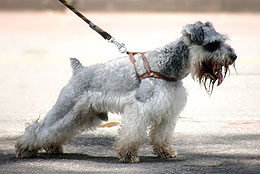 Leash pulling is a common issue concerning dogs and their frustrated owners. Although best solved early in a dog’s life, breaking a dog’s habit is not impossible. It is much easier, however, to train good behavior from the start than it is to overcome bad habits. Therefore walking politely on a leash is one of the fundamental lessons that a dog should learn while still young.
Because walking a pulling dog is irritating and often difficult, these owners will tend to walk their dogs less and less.
Unfortunately infrequent walks actually reinforce that dog’s tendency to pull, because they are so excited about getting out. Then the more the dog pulls, the more ingrained this habit becomes, which leads to the owner being less enthusiastic to take them out for a walk. This all leads to a downward spiral, with both the dog and owner becoming more and more frustrated.
Take a happy dog for a walk
For many dogs, the mere sight of their leash is a cue for instant excitement: whining, barking, and bouncing around in hyperactive bursts. But no matter how this looks, this is in fact not a show of happiness by your dog. With dogs, there is a vast difference between happiness and excitement. An excited dog is not comfortable – it is tense, bursting with energy, it breathes in quick, shallow gasps, has a racing heart and emits high whining yelps. This adrenalin-powered excitement sends the dog’s mind racing in a destructive energy. He is over-stimulated, rather than happy, and his nerves tell him to “fight or flee”. On the other hand, a happy dog is relaxed and content, with friendly, ‘soft’ eyes and no tension in his posture. His tail might wag, and he might prance energetically, but he’s calm, relaxed, and receptive. If you gave him a command, he’d obey.
Before you even get out the door, you want your dog calm and receptive to your leadership. If this pattern is not fixed now, it can only get worse with time. So firstly, it is important train him to behave himself whenever the leash is on the scene.
No walk until calm
An excited dog is more likely to disobey you, as they are too agitated to concentrate. The more often that happens, the more the leash will become a representation of a chance to ‘behave badly’.
Rule One: No walk until he's calm.
To achieve this, reward the behavior you want. Have him Sit-Stay while you attach the leash. If he starts to misbehave, stand up straight away, turn around and ignore him completely. Go and do something else until he has calmed down. Give him the command Sit-Stay again once he has been quiet for a few minutes and then try attaching the leash again. Repeat this until he makes no fuss when you put on the leash. You may have to go through the process of putting on and taking off the leash quite a few times initially before he realizes that he will not get a walk unless he behaves himself.
Once you are happy with putting him on the leash, it is time to take him outside. It is best to start with a short leash, as this will emphasize that you are the boss and will give you added control. Walk the dog on your left side, holding the leash with your left hand six inches from the collar. Run the leash across your body to your right hand and double it up in your palm, which will make it easier for you to control your dog's movement. If he lunges forward, stop walking immediately and turn back for home. This will show him that pulling on the lead will stop the walk and reinforces your Alpha dog status because you are controlling his movement.
Who’s running the show?
In the wild, the alpha wolf decides where the pack will travel to each day, as well as the movement of all the pack members. So if your dog rushes out ahead of you, strains against the leash, and forces you to go the way he wants to go, it is because he thinks he, as the alpha dog, is leading you.
You need to prove to him, through consistent leadership and ongoing control, that you are in charge and will decide where the two of you are going.
A technique that can gently begin to reinforce that is called "Random Walking". It's simple and highly effective and a mental workout for your dog. Random walking forces your dog to think and anticipate your moves, which is a great way to reassert your dominance.
Take your dog to a wide open space with few distractions, such as a quiet street, a front yard, a playing field, the local park. Put him on his leash and be sure that he is calm, so that he is most responsive. Keep the leash short so that he is next to you throughout the exercise and he has no choice but to go where you go.
- Start walking and take 5-10 steps then change direction without warning. Make a complete about-face or just head off to one side.
- Take a few more steps in that direction then change direction again.
- Take another couple of steps before making another random change. You will end up pacing back and forth, always in a different direction. Don’t forget to vary the number of steps you are taking so that you keep your dog guessing.
- You may want to try weaving in and out of trees, or breaking into a jog occasionally. Remember that variety is the key so be creative!
Keep the sessions short so that he remains attentive throughout. It is hard work for him as he has to be paying attention and thinking hard the whole time, looking to you for directions rather than choosing his own way. As you take him for more ‘random walks’, you will find that you are able to walk further and further in one direction without having him pull on the leash. After you've taken him random walking at least twice you'll find that you can walk further and further in one direction. Don't do this too often or too early though, as you want to keep him looking to your for leadership. Remember to reward him when he is walking politely beside you, be it with a treat or toy, or even just a pat, just so he knows that he is doing the right thing.
Make sure your dog still gets his daily exercise, as although random walking is mentally very tiring, it isn’t a substitute for normal exercise.
Older dogs may need more of your time and patience, however if you put in the hard work, you will most definitely reap the rewards of your efforts.
All the best,

Daniel Stevens and the Secrets to Dog Training Team
"Secrets to Dog Training - STOP Dog Behavior Problems!"
http://www.kingdomofpets.com/dogobediencetraining/
P.S. Forward this Newsletter to a friend
If you have a friend you think may be interested in training their dog or solving a particular dog behavior problem, please feel free to forward them this Newsletter.
P.P.S. Remember – you have full access to our Members’ Forum
Because you are a Member of ‘Secrets to Dog Training’ you have full access to our Members’ Forum. If you have a dog behavior question or a related problem, you are most welcome to bring it to the Forum. Post a detailed description for our trainers and fellow Members to read. Within 1-4 working days you will see recommendations on how to solve it once and for all.
If you haven’t already registered for the Forum, you can do this from the Members’ Area: http://www.kingdomofpets.com/dogobediencetraining/members/ or you can go straight there by clicking here – http://www.kingdomofpets.com/dog/forum/
Previous Newsletters
01 | 02 | 03 | 04 | 05 | 06 | 07 | 08 | 09 | 10 | 11 | 12 | 13 | 14 | 15 | 16 | 17 | 18 | 19 | 20 | 21 | 22 | 23 | 24 | 25 | 26 | 27
28 | 29 | 30 | 31 | 32 | 33 | 34 | 35 | 36 | 37 | 38 | 39 | 40