
Two bites too many
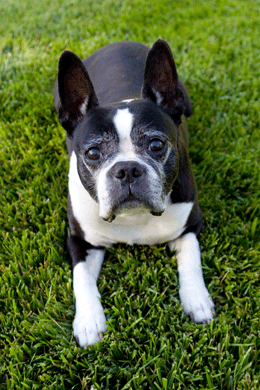 Barb writes: My family and I rescued a Boston Terrier named Zane about 2 months ago.
Zane is 6 years old and we don't know much about his history.
He has been a pretty well-behaved addition to our family and great with my two boys, aged 4 and 6.
My problem begins when I take him out on walks (on the lead). I walk him everyday. On two occasions he has bitten someone. I've been fortunate that the people he has bitten have been very forgiving but I'm now nervous about walking him and terrified at the possibility of him getting off the leash.
We just got through the holidays with many people coming and going and he did a great job... indoors.
I'm not sure what it was that set him off those two times. But we definitely cannot have a third.
Kingdom of Pets Replies:
It is definitely important to fix this behavior as soon as possible to ensure everyone’s safety. In the short term, it would be advisable to get Zane to wear a muzzle when in an outside environment, just until you gain control of his snappy behavior. This guarantees that he will not bite anyone, while buying you valuable time in which you can re-train him.
I would thoroughly recommend neutering him, if this has not been done already. This eliminates the added effect that high levels of hormones, such as testosterone, may have on his aggression.
Fear Aggression
It sounds as though the times he has bitten people on walks were due to fear aggression. He is on leash, and therefore feels restricted and more wary of strangers passing by. They pay him attention, fight or flight instincts kick in, Zane does not have the option of flight, so instead he fights.
Initially, it would be wise to try and avoid the problem by choosing ‘quieter’ times to walk Zane, such as early mornings and late evenings. Although you may be nervous about him biting someone again, using the muzzle will negate this risk. It is important that you keep exercising him, as this will keep him mentally as well as physically stimulated. If he is happy and healthy, he is less likely to act aggressively.
Cooping him up will only add to his frustrations, so that when he does get out he is likely to be quite agitated already, and so will react inappropriately to harmless situations. Often dogs that become overexcited or are insufficiently exercised become aggressive, because agitation is an uncomfortable state for them to be in.
Re-training Program
To begin with, it is important to make sure that Zane is clear that you are leader of the pack. It is a good idea to revisit the bonus book ‘Secrets to Becoming the Alpha Dog’, as this contains tips and simple steps to follow to ensure that Zane is clear that you are the Alpha dog.
I recommend you carry out obedience training on a regular basis and under a variety of conditions to de-sensitize his territorial instincts. The progression shown below has helped many people get better results from their dogs.
Begin your training sessions in an environment where Zane is comfortable and relaxed. Proceed to the next step in the series when you feel Zane is working the current step well.
Have Zane complete a 5-10 minute Sit-Stay and a 5-10 minute Down-Stay in each of the five settings listed below. These may seem to be quite basic commands but you are better to take things slowly and complete this program over a number of weeks, rather than rush things and become frustrated when the results are not as expected.
1. Inside the house, on the leash, with no other dogs or people present
2. Outside in a quiet surrounding, such as in park or the garden, on the leash, with no other dogs or people present
3. Outside still in a quiet environment, off the leash, with no other dogs or people present
4. Outside in a place with more distractions, on the leash, gradually introducing dogs and people to the vicinity
5. Outside with people and other dogs present, off the leash and running free
In order to test Zane’s behavior, ask a friend of yours that has not yet met Zane to be part of his training. At a neutral venue, one that Zane is not overly familiar with, have him ‘Sit’ with the friend in his sight but a long way away. You want his attention to be on you as your friend gradually comes closer. You may need to distract him initially whilst your friend is approaching, such as by giving him the Sit-Stay command and rewarding him when he obeys. He should eventually sit quietly until he is introduced to your friend. It is best to apply Alpha dog rules here by you greeting your friend first, before making the introductions between them and Zane.
Throughout this program, reprimand all bad behavior with ‘time-out’, by putting him in isolation and leaving him there for 5-10 minutes. Shouting at him or hitting him will only cause him to distrust and not respect you, which will lead to an uneasy relationship between you. Praise and reward him when he is behaving well, letting him know that he can “earn” your affection and attention. Make sure you aren’t giving out your attention freely, whenever he comes and asks for it, so that he will really value your attention and strive to achieve it.
Although the program may seem tedious and results not evident quickly, be patient with Zane and preserves with the training, and you can be sure that his aggression will vanish and his all-round obedience improve.
Out and About
When training Zane out of all aggressive tendencies, avoid play-fighting with him or playing tug-of-war with him. Although these may seem like simple games in moderation, it can ultimately be a recipe for disaster, because these will appeal to his competitive nature and he may see this as a chance to challenge for the alpha dog role.
When out on a walk, frequently use the commands you have been teaching him. You will need to keep him muzzled and on a short lead for safety and maximum control initially. The most important thing is for you to stay relaxed and calm, in full control of the situation. If you tense up and tighten your grip on his leash when you see another dog or person approach, Zane will sense your uneasiness and react.
During his walks, minimize Zane’s contact with strangers, even if he has been muzzled. The fewer confrontations he has at this time, the better it will be for his improvement. Once he has started to show progress in your controlled training situations, you can begin to socialize him a little more with other people, preferably with adult friends and family who will understand the work the two of you are doing! It will take a lot of patience and effort on your behalf, but you can rest assured that the fruits of your hard work will be well worth it!
All the best,

Daniel Stevens and the Secrets to Dog Training Team
"Secrets to Dog Training - STOP Dog Behavior Problems!"
http://www.kingdomofpets.com/dogobediencetraining/
P.S. Forward this Newsletter to a friend
If you have a friend you think may be interested in training their dog or solving a particular dog behavior problem, please feel free to forward them this Newsletter.
P.P.S. Remember – you have full access to our Members’ Forum
Because you are a Member of ‘Secrets to Dog Training’ you have full access to our Members’ Forum. If you have a dog behavior question or a related problem, you are most welcome to bring it to the Forum. Post a detailed description for our trainers and fellow Members to read. Within 1-4 working days you will see recommendations on how to solve it once and for all.
If you haven’t already registered for the Forum, you can do this from the Members’ Area: http://www.kingdomofpets.com/dogobediencetraining/members/ or you can go straight there by clicking here – http://www.kingdomofpets.com/dog/forum/
Previous Newsletters
01 | 02 | 03 | 04 | 05 | 06 | 07 | 08 | 09 | 10 | 11 | 12 | 13 | 14 | 15 | 16 | 17 | 18 | 19 | 20 | 21 | 22 | 23 | 24 | 25 | 26 | 27
28 | 29 | 30 | 31 | 32 | 33 | 34 | 35 | 36 | 37 | 38 | 39 | 40 | 41 | 42 | 43